


Read the full report
The Project Report provides detailed insights into deployment, performance evaluation, and lessons learned from one of the UK’s most significant adaptive traffic control implementations.
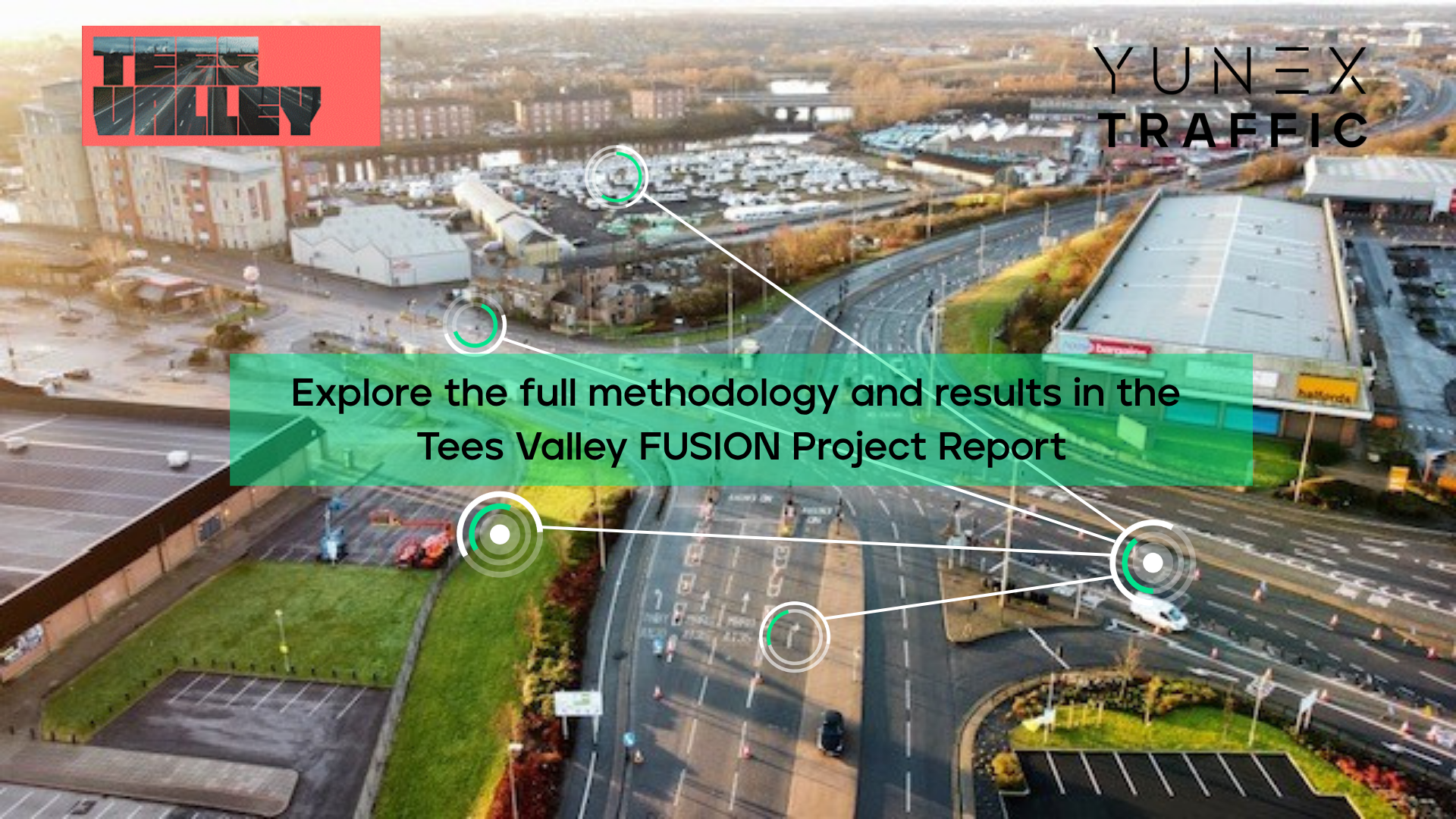
Poole, UK. 21 May 2026: Yunex Traffic’s FUSION adaptive traffic control solution has delivered measurable improvements in traffic performance across the Tees Valley, according to a newly published project report based on real-world deployment and independent monitoring.
The report documents one of the largest implementations of network-level adaptive traffic control outside London, demonstrating how data-driven optimisation can enhance the efficiency and reliability of urban road networks at scale.
Delivered as part of the Tees Valley Combined Authority’s wider Digital Transport Programme, Yutraffic FUSION represents a shift from traditional junction-level traffic management to a coordinated, network-wide approach.
Using real-time data from existing detection infrastructure, the system dynamically adjusts traffic signal strategies across multiple junctions simultaneously. This allows traffic flows to be managed more effectively across key corridors and urban areas, improving overall network performance.
The solution has been deployed across 196 signalised junctions within 57 coordinated regions, creating a fully-integrated, network-level optimisation system across the Tees Valley’s urban traffic management estate.
This large-scale implementation demonstrates how existing infrastructure can be enhanced through intelligent software to deliver improved outcomes without requiring wholesale system replacement.
A structured monitoring and evaluation programme assessed the impact of Yutraffic FUSION using independently sourced journey time data before and after deployment.
The findings show:
These measurable outcomes demonstrate the value of applying coordinated, data-led optimisation across multiple junctions rather than optimising routes in isolation.
Beyond operational improvements, the report highlights the strategic role of Yutraffic FUSION in supporting wider transport and economic goals.
By improving network efficiency and reliability, the system contributes to:
These benefits align with the Tees Valley’s ambition to deliver a smarter, more connected and more sustainable transport system.
The report also outlines how Yutraffic FUISON supports future digital transport capabilities, including integration with emerging Digital Twin technologies.
By combining real-time optimisation with predictive modelling and analytics, this approach enables a more proactive, data-driven method of managing transport networks – supporting both immediate performance improvements and long-term strategic planning.
The outcomes from the Tees Valley deployment provide a clear evidence base for other authorities considering intelligent traffic signal optimisation.
The findings show that the greatest benefits are achieved where optimisation is applied at a network level, particularly across coordinated corridors and high-demand routes.
This demonstrates the scalability and transferability of Yutraffic FUSION as a solution for urban transport authorities seeking to improve network performance using existing infrastructure and real-time data.
The Project Report provides detailed insights into deployment, performance evaluation, and lessons learned from one of the UK’s most significant adaptive traffic control implementations.

Bournemouth, UK, 16 November 2026: Yunex Traffic has been selected by Norfolk County Council to help keep people moving safely and efficiently across one of England’s largest counties. The long-term partnership focuses on maintaining and modernising the transport technology that supports everyday journeys and will bring benefits not only for road users, but also for…
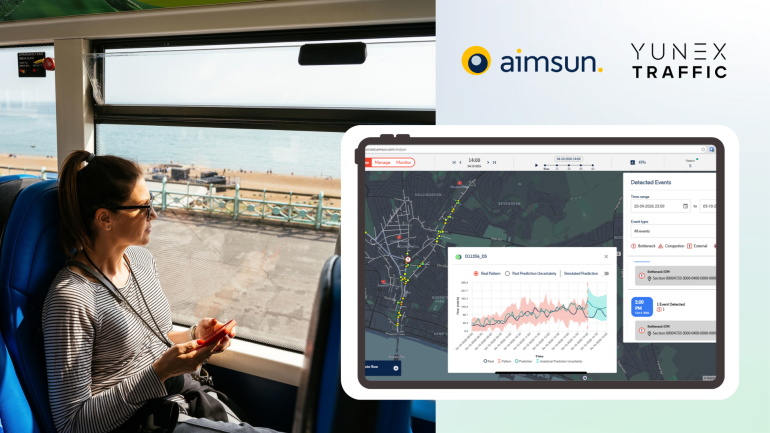
Bournemouth, UK: 7 October 2026: Brighton & Hove City Council selects Aimsun and Yunex Traffic to deliver a predictive traffic management platform that will improve bus reliability in Brighton city centre. Brighton & Hove City Council has appointed Aimsun and Yunex Traffic to deliver a state-of-the-art traffic digital twin for the city centre. The project…

Bournemouth, UK, 6 October 2026: Yunex Traffic has formally received the Defence Employer Recognition Scheme Silver Award at a Lord Lieutenant’s Awards ceremony, recognising their continuing commitment to supporting the Armed Forces Community. The Defence Employer Recognition Scheme Silver Award is a national award recognising employers that actively support current and former members of the…

Poole, UK: 24 September 2026: Yunex Traffic has partnered with Bournemouth School for Girls’ Robotics Programme to inspire the next generation of engineers, innovators, and manufacturing professionals as part of National Manufacturing Day 2026. Colleagues from Yunex Traffic have visited Bournemouth School for Girls to meet students involved in one of the UK’s most exciting…

Poole, UK: 4 August 2026: Bath and North East Somerset (B&NES) Council has chosen Yunex Traffic’s Stratos Urban Traffic Management and Control (UTMC) solution to replace its existing UTMC solution with a more efficient, resilient and future-ready approach to network management. Following a comprehensive review of its operational needs and an extensive tender process, the…

Poole, UK, 23 July 2026. Yunex Traffic has successfully completed the installation of its advanced video analytics solution Yutraffic awareAI in Coventry. Transforming how traffic is managed at complex traffic signal intersections, the solution uses advanced AI-trained machine learning to deliver detailed detection, classification, and data insight capabilities. The Coventry site presented a unique set of challenges, with multiple residential driveways located within the interior of the intersection not…